Evaluating the Noorale Google Slide Template for Professional Presentations
In the realm of digital communication, presentation design often serves as the critical interface between ideas and audience engagement. The Noorale Google Slide Template presents itself as a solution for this need, offering a structured framework for creating slides directly within Google Slides. This analysis examines its characteristics, practical utility, and suitability for various professional contexts, moving beyond promotional claims to assess its real-world application.
Core Functionality and Design Philosophy
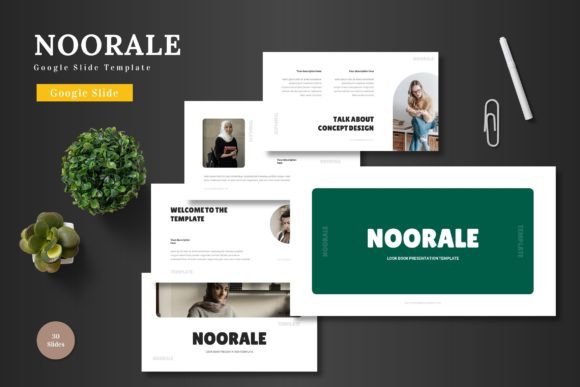
The Noorale template is a pre-designed set of slides intended to be used within Google Slides. Its primary value proposition is eliminating the need to build a visual foundation from scratch. The template provides a cohesive design system—including layouts, color schemes, and graphical elements—that users can populate with their own content. The description emphasizes a clean, scalable, and colorful aesthetic, which suggests a design aimed at modern, visually-driven presentations without being overly ornate or distracting.
A significant practical strength is its native integration. All editing is performed within Google Slides itself, utilizing the platform’s standard shapes and editing tools. This removes a common friction point: the need to export assets or use supplementary software like Adobe Illustrator or PowerPoint for advanced modifications. For teams or individuals standardized on Google Workspace, this seamless compatibility is a tangible benefit for workflow efficiency and collaboration.
Key Features and Practical Implementation
The feature set is substantial, with 150 total slides distributed across five premade color variations. This volume offers breadth, but its effectiveness hinges on organization and relevance. The inclusion of specific sections like portfolio slides and galleries indicates the template is designed for use cases such as product showcases, company profiles, or creative pitch decks. The handcrafted infographics and pixel-perfect illustrations, if well-executed, can save considerable time compared to sourcing or creating custom data visualizations.
The resizable and editable graphics, coupled with drag-and-drop picture placeholders, address a fundamental need for adaptability. In practice, this allows a user to maintain the template’s visual consistency while tailoring it to specific content—swapping in project photographs, adjusting charts to new data, or modifying icon colors to align with brand assets. The mention of animated slides introduces a dynamic element, though their utility depends on being purposeful and not gratuitous, which can enhance narrative flow in a live presentation.
Assessment of Quality and Usability
Quality in a template is judged by its foundational design and execution. A multipurpose template like Noorale must balance flexibility with coherence. Its master slide-based construction is crucial; if the master slides are thoughtfully designed, applying global changes (like font or primary color updates) across the entire deck becomes straightforward, ensuring visual reliability. The provided five PPTX files for widescreen format indicate the creator has also considered offline presentation scenarios, adding to its utility.
Usability centers on the learning curve and editing experience. Since it operates within the familiar Google Slides environment, the barrier to entry is low for most users. The real test is whether the template’s pre-built layouts logically support common presentation content blocks—executive summaries, feature lists, case studies, team introductions, and call-to-action sections. If the layouts are merely visually distinct but structurally impractical, users will spend time fighting the template rather than leveraging it.
Audience Fit and Ideal Use Cases
This resource is not for everyone. Its value is most pronounced for specific user profiles who prioritize speed, a polished baseline aesthetic, and consistency across multiple presentations.
Entrepreneurs and Small Business Owners
For individuals preparing investor pitch decks, product launch presentations, or business plan overviews, a template like Noorale can provide a professional veneer that might otherwise require a hired designer. The e-commerce and product promotion suitability mentioned aligns directly with these needs.
Marketing Professionals and In-House Creators
Marketers often need to produce campaign reviews, performance reports, or strategy proposals rapidly. A comprehensive template with infographics and portfolio slides can serve as a reusable asset library, ensuring brand presentation consistency across different team members and projects.
Educators and Freelancers
Those creating course materials, workshop slides, or client proposal presentations benefit from a structured starting point. The editable nature allows them to inject their personal or institutional branding while relying on a proven layout structure to organize complex information.
It is less suited for users requiring highly specialized, brand-specific designs that deviate dramatically from a modern, colorful aesthetic, or for those who prefer the utmost minimalist design with no graphical elements.
Long-Term Value and Potential Limitations
The long-term value of the Noorale Google Slide Template lies in its reusability and role as a foundational asset. If the master slides and core components are robust, a user or organization can adapt it for years, treating it as their internal presentation standard. This represents a significant return on investment compared to constantly purchasing niche templates or starting from blank slides for every new project.
Potential limitations must be considered objectively. First, the quality of the included illustrations and infographics is paramount; if they are generic or poorly constructed, they detract rather than add value. Second, a template with 150 slides can feel overwhelming if not well-organized, leading to users wasting time browsing slides rather than using them. Third, while color variations are offered, true flexibility depends on how easily the core color palette can be altered globally, beyond the five premade schemes. Lastly, the effectiveness of any template ultimately depends on the user’s content; a great design framework cannot salvage unclear messaging or poor data.
Final Observations and Recommendations
The Noorale Google Slide Template is a pragmatic tool for a clear demographic: professionals who use Google Slides and need to produce polished, visually-engaged presentations efficiently. Its multipurpose claim is tested by its inclusion of business, pitch deck, and portfolio-oriented slides. Before adoption, a prospective user should assess their typical presentation content against the template’s sample layouts to ensure compatibility.
For teams, adopting such a template can standardize output and reduce design overhead. For individuals, it can elevate the visual quality of their work without deep design expertise. The recommendation is to treat it as a starting framework, not a final product. Its greatest utility is realized when a user invests time to understand its master slides, customizes the core color and font to align with their identity, and then uses its components as logical containers for strong, original content. In that scenario, it performs as a valuable accelerator within the Google Slides ecosystem.