Crafting Impactful Narratives with the Métier Presentation Framework
In the realm of professional communication, the vehicle you choose to deliver your message is as critical as the message itself. For creatives, entrepreneurs, and corporate teams, a presentation is more than a slide deck; it is the narrative vessel for ideas, portfolios, and company profiles. A specialized tool designed for this exact purpose can transform a routine briefing into a compelling story. This is where the concept of a purpose-built creative presentation template enters the stage, offering a structured yet flexible canvas for diverse voices.
The Core Philosophy: Structure Liberates Creativity
Many assume that creativity requires a blank slate, free from constraints. In practice, however, unstructured freedom can often lead to inconsistency, wasted time on formatting, and a final product that lacks professional cohesion. The essence of a template like Creative Presentation - Métier is its foundational philosophy: a robust, intelligent structure liberates the creator to focus entirely on content and narrative flow. Métier, a term denoting one’s trade or specialty, hints at this precise approach—it provides the professional toolkit for the craft of presentation design.
Consider a photographer preparing a portfolio review or a startup founder crafting a pitch deck. Their expertise lies in their imagery and their business vision, not necessarily in the minutiae of slide master layouts or infographic construction. A pre-designed framework with handcrafted infographics and pixel-perfect illustrations allows them to operate within their métier, inserting their unique content into a visually coherent and aesthetically assured environment. This separation of content creation from design mechanics is a significant practical advantage.
Anatomy of a Versatile Presentation System
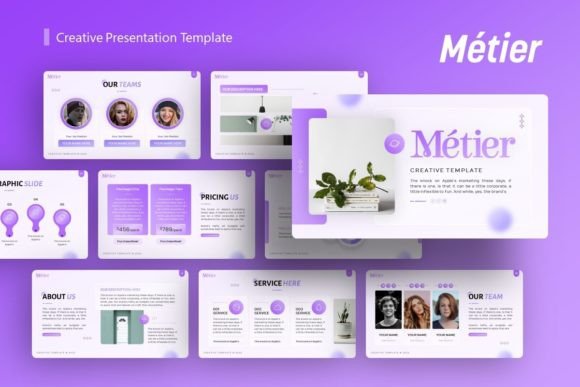
What constitutes such a system? The specifications reveal a toolkit engineered for depth and adaptability. At its core are 36 unique slides for each template variant, providing a comprehensive repertoire from title pages to detailed case studies, team profiles, data visualizations, and closing calls to action. This volume ensures that for most projects, a user will not need to create new slide layouts from scratch, but can instead select and sequence from a curated set.
The technical features underscore a commitment to professional utility. All graphic elements are resizable and editable, meaning the provided icons, charts, and illustrations are not static images but malleable components. This is crucial for branding alignment; a corporate user can adjust colors to match their palette, or a creative agency can tweak shapes to better reflect their style. The inclusion of picture placeholder with drag-and-drop functionality speaks directly to real-world workflow, streamlining the often tedious process of image insertion. Furthermore, being based on master slides in PowerPoint ensures global changes—like font updates or logo placement—can be applied universally, maintaining consistency across a lengthy deck.
Primary Use Cases and Real-World Application
The utility of a multifaceted presentation template is best understood through its applications. Its design caters to a spectrum of professional needs, each with distinct storytelling requirements.
- Creative Agencies and Portfolios: Here, visual storytelling is paramount. The template’s strong layout for image display, combined with elegant text framing, allows agencies to present past work, client case studies, and team expertise in a manner that itself reflects creative competence. A photography portfolio, for instance, benefits immensely from slides designed to showcase visuals as the primary focus, with minimal, supportive text.
- Corporate and Business Profiles: For annual reports, company introductions, or department overviews, the need shifts toward data clarity and brand authority. The handcrafted infographics become vital tools for translating financial results or market research into understandable, engaging visuals. The corporate user leverages the master slide system to enforce brand consistency across every slide.
- Startup Pitch Decks: This is a high-stakes application where clarity, persuasion, and pace are critical. A pitch deck must quickly establish problem, solution, market, and team. A structured template provides a logical sequence, preventing founders from omitting key sections. The professional design also lends credibility, suggesting that the startup operates with maturity and attention to detail.
- Personal Portfolio: Individuals, such as freelance designers or consultants, often lack the resources of a larger firm. A comprehensive template offers them a ready-made professional presentation standard, enabling them to compete on visual polish while concentrating their effort on curating their personal work and achievements.
It is important to note a common consideration: the demo images shown in template previews are typically for demonstration only. The actual user supplies their own photographs, logos, and data. This distinction underscores the template’s role as a framework, not a finished product. Its value lies in its editable architecture.
Strategic Advantages in Professional Communication
Adopting a specialized presentation framework brings a cluster of strategic benefits that extend beyond mere time-saving.
First is Speed to Production. In fast-moving business environments, the ability to rapidly assemble a client-ready presentation is a competitive advantage. With customizable contents and a large slide library, a draft can be constructed in hours rather than days.
Second is Consistent Quality. Human perception is subtle; inconsistencies in font sizing, alignment, or color usage can unconsciously undermine credibility. A template enforces a visual standard across all slides, ensuring the final output feels polished and unified, regardless of which team member assembles it.
Third is Focus on Narrative. By removing the constant design decisions, the presenter’s mental energy is redirected to the story’s logic, the key messages, and the audience’s journey through the content. This often results in a more persuasive, clearer, and more impactful presentation.
Finally, there is the advantage of Adaptability. The very design of such a template, with its resizable graphics and editable elements, means it is not a one-time tool. It can be repurposed across different projects within the same organization, evolving slightly for each use but maintaining a recognizable family resemblance that strengthens brand identity.
Implementation and Customization: A Practical Workflow
Understanding the features is one step; integrating them into a workflow is another. The process typically begins with reviewing the included documentation file to understand the master slide structure and the scope of the 36 slides. Next, a user would open the PowerPoint .PPTX file and likely start by customizing the master slides—setting the primary and secondary fonts, establishing a color scheme that aligns with their brand, and perhaps adding a permanent logo or footer.
From there, building the presentation becomes a process of selection and population. Users browse the slide library, duplicate the slides that fit their narrative sequence, and then fill them with their content. Text is replaced in the provided text boxes. Images are dragged into the picture placeholders. Infographics are edited to reflect their specific data—perhaps changing the values on a chart or the icons on a process flow diagram. The vector icons offer another layer of customization; they can be recolored, resized, or even combined to create new visual metaphors.
A key observation from experienced users is that the most effective use of such a template does not mean using every slide. It means curating the slides that serve the specific story. A ten-slide pitch deck might select only a handful of the available layouts, ensuring each one serves a distinct and critical purpose in the argument.
Navigating Common Considerations
While the benefits are clear, successful adoption involves mindful consideration. One consideration is the balance between template structure and unique brand expression. A template provides a starting point, but the final output should feel like the user’s own. This is achieved through deliberate customization—not just changing text and images, but adjusting color palettes, perhaps modifying illustration styles, and sequencing slides in a novel way. The goal is to use the template as a skilled carpenter uses a pre-cut joint: it ensures structural integrity, but the final shape and finish of the furniture are unique.
Another consideration is audience appropriateness. While the template is versatile, the user must still judge whether its inherent visual style—which might lean modern, clean, and creative—is perfectly suited for, say, a highly conservative financial audience. The editable nature allows for tonal adjustment, but the initial aesthetic direction is a factor.
Finally, there is the ongoing evolution of content. A presentation is rarely static. As projects evolve and portfolios grow, the deck will need updating. The master slide-based system greatly simplifies these future revisions, allowing for global updates and ensuring that new slides added later maintain consistency with the original ones.
The Enduring Value of a Designed Narrative Framework
In conclusion, the practical relevance of a comprehensive creative presentation resource like the Métier framework lies in its dual role as an accelerator and a quality safeguard. For the broad audience of professionals, business owners, educators, and creators, it addresses a common pain point: the disproportionate effort spent on design formatting versus content crafting. By providing an ecosystem of easy customizable contents, a wealth of starting slides, and professional-grade graphical assets, it empowers users to produce work that communicates with clarity and visual confidence.
The true measure of such a tool is not in its feature list, but in the narratives it helps its users successfully tell. When a startup secures funding using a clear, compelling pitch deck built on its foundation, or when a photographer wins a client through a portfolio presentation that elegantly frames their art, the template’s purpose is fulfilled. It becomes an invisible partner in the process, upholding the standards of presentation métier while the user focuses on the substance of their own specialized craft. In a world where effective communication is paramount, having a reliable, adaptable structure for your most important stories is not just a convenience; it is a strategic asset.