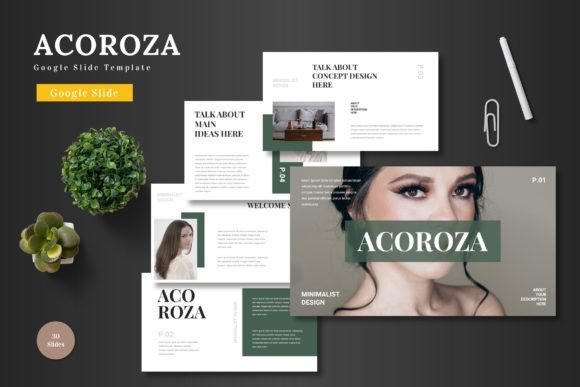
Choosing the Right Foundation: The Acoroza Google Slide Template in Modern Workflows
For professionals across industries, the initial stage of creating a presentation is often the most daunting. It's not the content itself—the data, the insights, the story—but the visual framework that must house it. A blank slide is a canvas of infinite possibility, which for a busy individual translates to a significant time investment in design decisions. This is where a thoughtfully constructed template like the Acoroza Google Slide Template enters the workflow, serving not as a final product, but as a foundational starting point.
The Acoroza Google Slide Template is a comprehensive digital asset designed for Google Slides. Its core purpose is to provide a structured, visually cohesive starting layout, complete with master slides, infographics, and placeholder systems. It acts as a bridge between the raw material of your ideas and the polished, professional presentation you need to deliver. It fits into the broader creative and strategic process by handling the universal design overhead, allowing you to allocate cognitive resources to messaging, narrative flow, and audience engagement.
Integration into Project Planning and Execution
The integration of a tool like this typically occurs at the project planning phase. Before deep content creation begins, selecting and applying the template establishes the visual language of the entire project. This decision impacts all subsequent steps. For a marketing team launching a new campaign, applying the Acoroza template at the kickoff meeting ensures that every internal review deck and final client presentation maintains brand consistency. For an educator planning a semester's lectures, importing the template into a dedicated folder for each module guarantees a uniform learning experience for students, where the structure is familiar and only the content changes.
This pre-content application is crucial for organization and efficiency. By setting the color scheme, font styles, and layout grids upfront via the template's master slides, you eliminate hundreds of minor formatting decisions later. The workflow transforms from "design and write" to "write and place." The five premade color variations offer immediate thematic alignment—choosing a cool, professional blue for a corporate financial report, or a vibrant, energetic palette for a creative portfolio—without requiring color theory expertise.
Interplay with Other Tools and Assets
A template does not exist in isolation. The Acoroza Google Slide Template is designed for compatibility within the Google ecosystem. Its primary file format is native to Google Slides, ensuring full functionality with the platform's collaborative features. Team members can co-edit in real time, comment on specific slides, and maintain version history without the friction of converted file formats. This seamless interaction supports modern, distributed workflows where input from designers, content writers, and subject matter experts must converge smoothly.
The template also interacts directly with your existing digital assets. Its drag-and-drop picture placeholder and gallery slide designs are engineered for practical implementation. When a photographer compiles a portfolio presentation, they can directly pull images from their cloud storage or local drive into the predefined frames, knowing the sizing and cropping will be handled by the template's layout. The resizable and editable pixel-perfect illustrations allow for further customization; a business analyst can modify an included chart graphic to reflect their specific dataset without starting from a basic shape tool.
This reduces dependency on advanced graphic design software for simple edits. The process becomes more streamlined: gather your data in Sheets, draft your narrative in Docs, and assemble your visual story in Slides using the pre-structured Acoroza framework. It serves as the central hub where various preparatory work is synthesized.
Practical Implementation and Workflow Enhancement
Adopting a template requires a slight shift in approach to reap its full benefits. A practical first step after acquiring the Acoroza Google Slide Template is to explore its architecture. Open the master slides to understand the underlying design rules—the defined text boxes, the color palette applied to shapes, the default font for headings and body text. Familiarity here prevents accidental "breaking" of the design later. Next, perform a test run. Create a dummy presentation using all the major slide types: title slides, section breaks, infographic layouts, and portfolio galleries. This hands-on test reveals how the components work together and builds confidence before a high-stakes project begins.
For long-term use and quality control, consider creating a standardized organizational system. Many users duplicate the original template file and rename it for each new project, preserving the source as an untouched master copy. This practice ensures you always have a clean, consistent starting point, and it avoids the degradation that can happen when a single file is endlessly modified for disparate purposes. The included readme file with font and photo information is a critical resource for this consistency, ensuring you can source matching typefaces or stock imagery if you need to expand beyond the template.
Supporting Diverse Use Cases and Outcomes
The utility of a structured template extends across the professional spectrum. An entrepreneur pitching to investors needs to convey credibility and clarity. Using the Acoroza template's clean layouts and handcrafted infographics, they can map out their business model, financial projections, and market analysis in a format that feels authoritative, without diverting weeks of effort into slide design. The section break slides provide natural pacing points, allowing the presenter to segment the pitch into digestible chapters.
For a freelance blogger or content creator, the template serves a different function. It can be the engine for producing consistent visual content for their website or social media channels. Slides can be exported as high-quality images or PDFs to accompany articles or serve as lead magnets. The 150 total slides across five colors offer a vast library of visual arrangements for different topics, making the production of complementary graphics a rapid task rather than a creative bottleneck.
Educators and trainers find particular value in the template's ability to structure complex information. The infographic slides based on master layouts are ideal for breaking down processes, illustrating hierarchies, or comparing concepts. This visual standardization aids learning retention. Furthermore, by modifying the template slightly for different courses or modules—perhaps by using a different color variation for each subject—they create a subtle visual coding that helps students mentally organize their coursework.
Factors for Smooth Integration
Successful integration hinges on a few key factors beyond the technical features. First is alignment with intent. Assess whether the template's aesthetic—through its illustrations and color schemes—matches the tone you need to project. Its professional, modern design is versatile, but ensuring it feels right for your specific audience is a preliminary step. Second is usability within your team. If multiple people will edit presentations, ensure they have basic orientation to the template's features, like using the pre-formatted text boxes instead of adding new ones, to maintain design integrity.
Finally, consider the template as part of a quality control cycle. Using a consistent foundation like the Acoroza Google Slide Template makes reviews more efficient. Stakeholders or supervisors can focus their feedback on the content and narrative, rather than being distracted by inconsistent fonts or misaligned elements. It elevates the conversation from basic formatting to strategic messaging. Over time, this creates a library of presentations that share a cohesive visual identity, strengthening brand recognition or personal professional reputation.
The Acoroza Google Slide Template, therefore, is more than a collection of slides. It is a workflow catalyst. By providing a robust, editable, and visually coherent starting point, it shifts the effort from foundational design to targeted content creation and strategic assembly. It interacts seamlessly with the collaborative tools and digital assets professionals already use, fitting naturally into planning, execution, and review phases of project management. Its value is realized not in the template itself, but in the time reclaimed, the consistency achieved, and the professional polish it enables across countless presentations, pitches, lessons, and reports in the dynamic workflows of modern work.